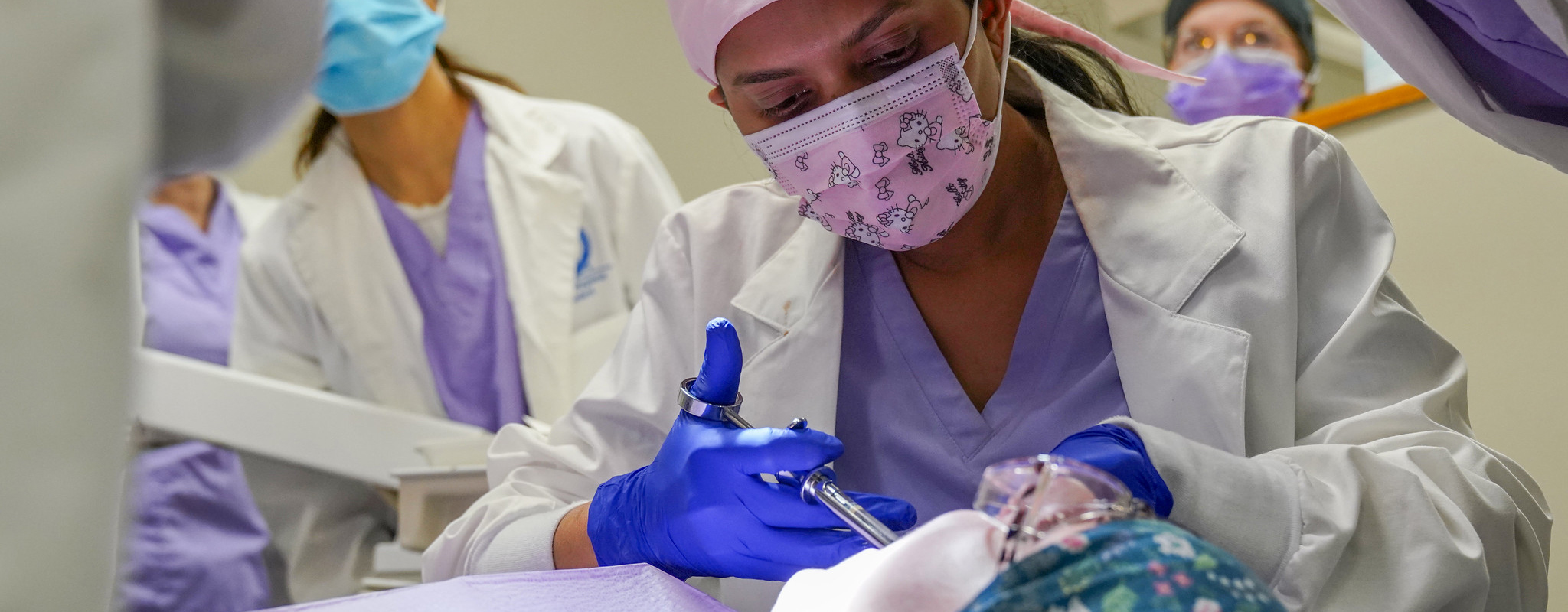
Sandburg offers an associate in applied science in dental hygiene. Our hands-on program prepares you to become a dental hygienist in two years (including one summer). This limited-enrollment program successfully prepares you to take the national dental hygiene board examination, the clinical dental hygiene board examination and the examination for registration as a dental hygienist in your respective state.
Sandburg also offers students the opportunity to participate in the Student American Dental Hygiene Association (SADHA) student organization. Learn more, and join today.
Admission requirements
This is a limited-enrollment program. You can apply online from Oct. 1 to March 24. The application deadline date is March 24 for fall enrollment. The dental hygiene academic advisor reviews admissions requirements and application eligibility before you apply to the program.
Additional requirements
Although not required, you may wish to complete some of the required dental hygiene program general education courses before you start the program because of its rigorous quality. General education courses don’t have to be taken at Sandburg; just make sure you verify course equivalences before you enroll in courses elsewhere. All courses, including all program courses and prerequisite courses, must be completed with a grade of C or better. Additionally, you must:
- Have a minimum of 23 admission points as calculated on the admission points worksheet.
- Complete the following courses with a grade of C or higher.
- BIO 101 – General Biology or equivalent and CHM 100- Concepts of Chemistry or equivalent*
OR
-
- BIO 211 – Anatomy and Physiology 1* and BIO 212- Anatomy and Physiology 2*
and BIO 200 – General Microbiology *
- BIO 211 – Anatomy and Physiology 1* and BIO 212- Anatomy and Physiology 2*
- Complete the online application.
Background checks, vaccinations
- Criminal background check: A criminal background check is required before entering the program. Findings on the criminal background check may void conditional/full admission and prevent entrance to the program. If you’ve been convicted of a felony, consult the laws concerning licensure in the state or states you want to practice.
- CPR certification: This program requires CPR certification. Before entering dental hygiene classes. Details for this requirement are presented at the mandatory orientation meeting.
- Required vaccinations: measles, mumps, rubella, chicken pox, 2-step TB, hepatitis B, and TDaP vaccines. Details for these required vaccinations are presented at the mandatory orientation meeting.
- COVID-19 vaccination: Although not an admission requirement, most healthcare clinical sites require vaccination against COVID-19. Check with your program coordinator for more details.
There are 30 seats in the program annually. Of the 30 seats available each year, spaces are reserved for Sandburg, Spoon River College, Black Hawk College, Southeastern Community College and Eastern Iowa Community College residents; any remaining spaces are available to include other districts.
Sandburg reserves the right to postpone the start of a program or cancel the program based on enrollment numbers, clinical site availability and/or instructor availability.
*All 200-level biology courses must be less than seven years old at the time of application.
Program goals
Dental hygiene students will:
- Complete all college requirements to attain an associate in applied science degree.
- Gain the knowledge and skills necessary to be a competent entry-level dental hygienist.
- Exhibit the values and skills necessary for lifelong learning and self-improvement.
- Manage the ethical and professional responsibilities of the dental hygiene profession.
Dental hygiene jobs
Dental hygienists work in various capacities, including clinical practice, education, sales and marketing, research, public health, administration or entrepreneurs. Flexible hours are common.
- Employment of dental hygienists is expected to grow much faster than the average for all occupations through 2031.
- The median hourly salary of dental hygienists was $45.32 in May 2024. Earnings vary by geographic location, employment setting and years of experience.
- Flexible scheduling is a a definite perk. Full-time, part-time, evening and weekend schedules are widely available. Hygienists frequently work only two or three days a week; so they can hold jobs in more than one dental office, if desired.
- Dental hygienists work in offices that are clean and well-lit, and they must follow important health safeguards, including wearing safety glasses, masks and gloves to protect themselves from bloodborne pathogens and infectious diseases.
Source: U.S. Bureau of Labor Statistics
Accreditation & licensure
Accreditation
The dental hygiene program has been approved by the Illinois Community College Board and the Illinois Board of Higher Education. The program is accredited by the American Dental Association Commission on Dental Accreditation and has been granted the accreditation status of “approval without reporting requirements.” The commission is a specialized accrediting body recognized by the United States Department of Education.
Contact the Commission on Dental Accreditation at:
211 E. Chicago Avenue
Chicago, IL 60611
312.440.4653
Accreditation Commission comment request form.
Licensure
Graduates from the dental hygiene program are eligible to take the national dental hygiene board examination, the respective clinical dental hygiene board examination and the examination for registration as a dental hygienist in the respective state.
Sandburg’s dental hygiene program meets the state education requirements for a registered dental hygienist license in the states of Illinois and Iowa, but may not meet the state education requirements in any other state, any U.S. Territory or the District of Columbia. Contact the state regulatory agency for dental hygiene in those states directly.
Sandburg dental hygiene board scores
Credentialing exam pass rates
PROFESSIONAL LICENSURE DISCLOSURES
Postsecondary institutions participating in federal student aid programs are required to make certain disclosures to enrolled and prospective students, parents, employees and the public. The U.S. Code of Federal Regulations (34 §C.F.R. 668.43) requires disclosures by institutions regarding educational requirements for programs leading to professional licensure or certification regardless of modality. The institution must make readily available to enrolled and prospective students information about whether programs leading to professional licensure or certification meet educational requirements.
View licensure information by state for dental hygiene, medical imaging programs, medical assisting and mortuary science. If Sandburg hasn’t determined whether a program meets the educational requirements for licensure or certification outside the state of Illinois, contact the licensing entity to determine whether it meets the educational requirements for licensure or certification in the state you live or work.
Email the associate vice president of nursing and health professions with questions.
Sample course schedule
This is a sample class schedule, which is subject to change.
First year: Fall semester — 16 weeks
Class schedule
DHG 114
DHG 110
DHG 115
BIO 211
DHG 112
DHG 113
BIO 211 lab
DHG 115
DHG 110
DHG 114
BIO 211
DHG 109
First year: Spring semester — 16 weeks
Class schedule
DHG 118
DHG 119
DHG 125
DHG 125
DHG 125
DHG 120
DHG 125
DHG 125
DHG 125
ENG 101, SOC 101
Labs TBD — can run as late as 9 p.m.
First year: Pre-summer session — three weeks
Class schedule
DHG 200
DHG 200
DHG 200
DHG 200
First year: Summer session — 8 weeks
Class schedule
DHG 205
4 p.m.-5:45 p.m.
BIO 200
DHG 205
DHG 205
4 p.m.-5:45 p.m.
BIO 200
DHG 205
Second year: Fall semester — 16 weeks
Class schedule
DHG 211
DHG 213
DHG 215
DHG 215
DHG 215
DHG 212
DHG 210
DHG 215
DHG 215
DHG 215
DHG 215
NUT 110
Labs TBD — can run as late as 9 p.m.
Second year: Spring semester — 16 weeks
Class schedule
DHG 217 (2 wks)
DHG 225 (14 wks)
DHG 217 (2 wks)
DHG 225 (14 wks)
DHG 217 (2 wks)
DHG 225 (14 wks)
DHG 217 (2 wks)
DHG 225 (14 wks)
DHG 220
DHG 218
DHG 217
DHG 217 (2 wks)
DHG 225 (14 wks)
DHG 217 (2 wks)
DHG 225 (14 wks)
DHG 217
DHG 219
Labs TBD — can run as late as 9 p.m.
Program total: 78.5 credit hours
Course information
Class formats
Sandburg offers courses in a variety of formats to best fit your needs. Regardless of the format, make sure you have access to a reliable computer with high-speed internet. All courses use online resources and require you to access course information through mySandburg. The Galesburg and Carthage campuses have open computer labs for your use as a student.
Dental hygiene AAS
Estimated program costs and tuition breakdown
$20,789.50
Estimated total cost
Includes tuition, books, supplies and fees
$19,327
Based on 78.5 credit hours
$2,995.48
Estimated tools and supplies
$1,462.50
Program and administrative fees
Financial aid, grants & scholarships
Learn how you can take advantage of financial aid, grants and scholarships available to Sandburg students.
Workforce Innovation and Opportunity Act
The Workforce Innovation and Opportunity Act (WIOA) helps job seekers access employment, education, training, and support services to succeed in the labor market and to match employers with the skilled workers they need to compete in the global economy. Learn more, and complete this form to determine your eligibility.
FAQs
Preference is given to qualified applicants who are residents of the Sandburg district or partner districts.
Refer to the admission selection points worksheet for ranking criteria.
Applicants will be notified at their Sandburg email address approximately two weeks after the application deadline whether they are accepted into the program, receive conditional admission, receive alternate status, or are denied.
If no balance remains, it may be refunded after the 100% drop date. If a third party paid the fee, refunds go to them.
If you accept and then withdraw, the fee is forfeited. Alternates not admitted will receive a refund.
Career and technical programs/courses follow our equal opportunity & non-discrimination statement . For more information, email the Title IX coordinator or call 309.341.5258, or contact the ADA/504 coordinator at 309.341.5262.
Notice to patients and potential dental hygiene applicants:
Enrolled students and patients are exposed to bloodborne pathogens. These include (but aren't limited to) pathogenic microorganisms present in human blood and have the potential to cause diseases. The Bloodborne Pathogen policy is available in the dental hygiene program manual as well as by contacting the dental hygiene department.